3 January 2012

More Dispatches from Spain

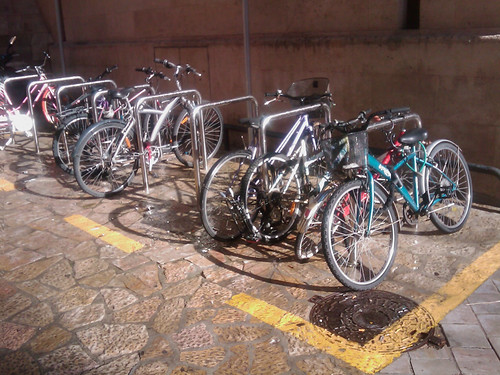
Bikes on stands
Bike Parking in the centre of Palma de Mallorca

We return from Spain again encouraged by the progress and openess we see there to alternative means of transport. Of course, they are still largely in thrall to the motor car (and moped), but there are definite green shoots in terms of a growing cycling culture. The beauty of a country like Spain is that whilst they remain very car orientated, people are very quick to adapt to and accept new ideas. They seem to have an in-built sense of civic duty that means that if something is suggested that will clearly have benefits for the civic realm then there seems to general acceptance, if not always complete support. This stands in contrast to the more overt conservatism in the UK, where new ideas are generally regarded with suspicion at best. I like to think that the focus on public space and quality urban realm that typifies a Spanish city like Palma de Mallorca comes from this belief in the idea of "civitas". Perhaps this is one of the cultural influences bequeathed to Spain by it's Moorish occupiers centuries ago.
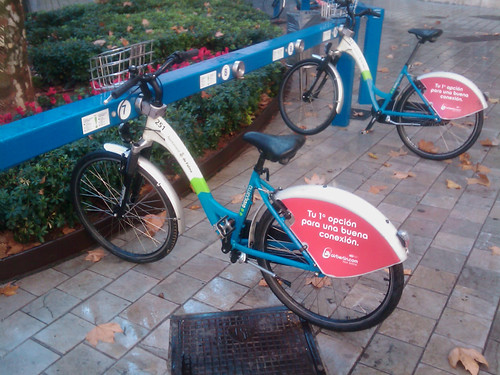
Bike share scheme
Typical docking station

Either way, the green shoots are in evidence in Palma. In addition to the now a-typical bike hire scheme, carried out with the usual Spanish commitment and panache, there are also new cycling infrastructure interventions all over the city. They may be sub-standard when compared with best practice, such as the painted lanes that cross Plaza Espanya in a rather unlikely fashion, but there are also new two-way lanes with separating kerbs that have been borrowed from the carriageway and newly installed two-way lanes forming part of widened footways. The beginnings of what could become an extensive network are in place, mostly in the form of segregated routes - something that we can't sneer at at all in the UK, regardless of the criticisms that could be levelled at the two-way style and narrow widths.


What makes the difference is when the Spanish decide to do something, they do it the best they possibly can. Not just a can of spray paint; but taking lanes from traffic, closing some streets altogether to cars, introducing bike friendly crossings, having bike/pedestrian priority crossings at junctions etc etc. they recognise the compromises that inevitably stem from believing bike is best, and accept them. All too often in the UK, you get the sense that planners and engineers know they have to do something, but can't quite stomach the true consequences of that decision and we end up with the useless, underused and often dangerous rubbish that passes for cycling infrastructure here.
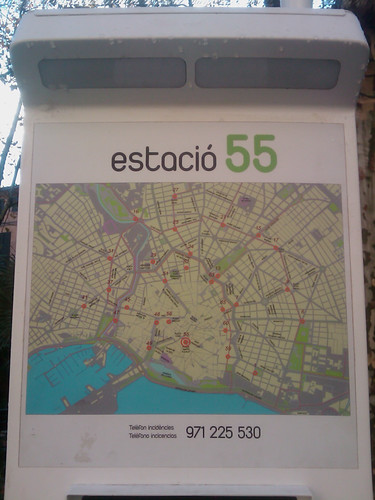
Bike share stand
Bike network map on docking station

Beyond the evidence literally on the ground, there are also actually people on bikes. There are bikes parked on stands that once would have been all for mopeds. There are bike shops doing bike maintenance and selling stylish fixies. There is advertising using bikes as the backdrop. The next time I am there, I am sure that the balance of sensible upright bike v cheap knobbly tyred mountain bike with unsuitable suspension will have shifted in favour of the more elegant way to travel, and lo, a utility bike culture will have taken hold. Don't forget that sport cycling in Spain is a major deal, much more so I suspect than in the UK, so getting people to consider cycling for transport rather than just sport is perhaps a bigger stretch, although equally more people are used to cycling regularly. The point is that when I first came here 9 years ago, a bicycle would have been a rare beast in the city. Not now. There are painted bikes on the surfacing of segregated cycle paths, and real ones riding over - two facts not unrelated, I believe.

19 December 2011

A (Very) Occasional Series

Obscure Reasons for Cycling: Number 1

Photo Courtesy of BenettonTalk
I realised today that it has been many days since I was inspired to write anything here. However, this is mainly because most of the things I would like to write about the cycling, infrastructure and the gentle art of persuading the masses that they've got it all wrong is already being written, at this very moment, by much cleverer and erudite folk than me.

Nevertheless, I also thought that the more obscure benefits of cycling to work could probably do with an airing, just in case it gets forgotten that it is the simple things in life that matter. After all, who really cares about how many kilogrammes of CO2 they omit into the atmosphere at any given moment? Or how their long term lifestyle choices will shave 20 minutes off their life expectancy?

No, what we want is the here and now. And I noticed right here and right now that cycling to work has made a dramatic difference in the number of shoes I wear out per-annum, since I stopped walking to work.

I expect a drastic shift from pedestrian activity to the cycling world as soon as news of this dramatic finding gets out. In austerity Britain, watching the pennies is where it's at.

28 November 2011

The Green Grid

We have been doing some research into the way that Cardiff can be read as a city. Our thesis is that the park sof Cardiff are it's key characteristic, and can therefore be used as the structuring element that can organise the whole.

We propose that the main "anchoring" parks of Cardiff can become the attractors at the ends of green fingers that stretch out into the suburbs and beyond. Where an anchoring park is missing, then current landfill sites can be re-imagined as the new urban parks that perform the anchoring role that the great Victorian parks do elsewhere.

These green fingers are mostly already in-situ, and the axial (from outside to centre) connections are strong. Where the connectivity of this network fails is in the radial (radiating out from the centre) direction. The green grid needs to be augmented by creating links, joining pocket parks, greening previously derelict or brownfield land.

This green grid of connected parkland and found green space conveniently forms a new transport grid overlaid over the old and defunct road system, but luckily just for bikes and pedestrians. Here is our initial proposal which comes with a healthy debt of respect to Dr Beehooving at CycleSpace, of course, who is the pre-eminent expert in the field.

Presented at the Welsh School of Architecture, Post-Industrial Seminar, November 2011.


14 November 2011

There is no School Like the Old School

We made a trip to St Fagan's recently - the Museum of Welsh Life in Cardiff which is one of the most popular open-air museums in Europe.

This building is an old barn where the columns are made of solid massive slabs of slate, and the rear building is made of small pieces of slate laid horizontally like a dry stone wall.

For some reason, this is utterly appealing to architects. Perhaps it is the reassuring idea that the concept of modernism is completely encapsulated by a medieval barn, and is therefore less scary than the rantings of that madman Le Corbusier. In a survey*, the vast majority of architects asked about their favourite building at St Fagan's chose this one. I'm sure there is an essay there somewhere.

*we asked at least 3.

For those bike fans out there, do not fret. Here is a classic cargo bike I found hiding under a pile of tin baths and buckets in the shop that is part of the village grouping at the museum. It should be centre stage, and probably is an a parallel universe where people are sensible and value bikes not buckets. Again, an essay beckons...

31 October 2011

Car Day

This post is in homage to Dave Warnock who has just achieved the milestone of cycling everyday for one year, and whose regular comparisons of his travel experiences cycling and driving are always a good read.

I had a meeting in Swansea last week, for which I had to take the car (issues of meeting clashes and giving lifts to colleagues). On my return, I was able to park in the office car park in the centre of town. I then had to pick up No.1 son from his nursery – barely half a mile away and approximately 7 minutes by bike, whatever the traffic – at the end of the day. I was careful and left a bit of extra time – leaving about 25 minutes for a journey you can walk in about 10. However, I was totally flummoxed by the sheer volume of traffic and so at 10 minutes to six (six is the dreaded cut-off time – otherwise you get fined), I had to ring my partner and beg her to jump on her bike and dash to the nursery as I didn’t think I was going to make it. In the end, she beat me by about 1 minute and I arrived at about 30 seconds to six. She travelled easily twice the distance I had to. I normally arrive to collect my son cheerful, and full of fresh air. This time I arrived completely stressed, panicking and frustrated.

I had time (unfortunately) whilst sitting in a solid jam of cars to reflect on the advertising method of promoting cars as tools of freedom, choice and practicality. Those advertising gurus must be geniuses to have conned so many into believing it. Can you imagine my frustration at being 500yds away from my boy, but with no way to get there and no alternative but to sit it out? If I have to take my car again, I’ll chuck the Brompton in the boot and use that at the end of the day – the car can stay in the car park.

I’m beginning to resent the gas-guzzling, money draining, time wasting appendage outside. But will we have the guts to get rid of it? To be honest, I doubt it. Until transport thinking catches up with the unarticulated desires of (I believe) many people, and starts considering genuine alternatives, once again that is a choice our addiction to the motor car has denied me rather than enabled - the choice to do without.