
29 August 2017


4 September 2015


17 December 2013

22 October 2013
18 October 2013
What Do We Do Now?
This is a piece I wrote some time ago on the subject of getting my son to school. In my mind, this is a fundamental illustration of why segregated cycling facilities have to be the future. He is now nearly 6, and the problem remains.
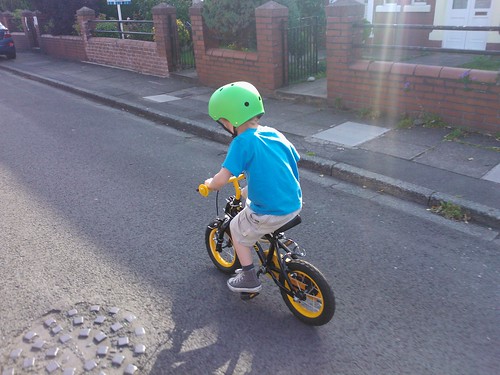
A few weeks ago, I was delighted to be able to tweet a message that my 4 yr old son had successfully negotiated one of life's more memorable milestones - he had made his first solo flight on his little black and yellow bike; stabiliser free and wind in his hair. What a little belter.
He has since practised hard, and has subsequently added "the launch" to his skill set, plus some pretty advanced cornering abilities. I've even raised the seat as he's grown. If he could only master stopping (he keeps forgetting where the brakes are) we'd be sorted. No doubt he'll get it eventually.
This is a brilliant development, and just in time for mum and dad, as he has outgrown the rear bike seat he used to use on his mum's bike. He is also starting to get too big for the IT Chair on my Brompton; or at least he's getting too heavy for my feeble pedalling efforts to actually propel us forward.
But, despite our pride in his achievements, and pleasure at his progress, we do have a problem. What do we do next?
I mean, he's only 4. He lacks any understanding of the rules of the road. He's a bit wobbly too - it's only been a few weeks after all since he got the hang of it. How can he develop and utilise this new ability? Why not ride to school?
Fortunately for us, we thought, his new primary school is accessed via a back lane and is only about 250m from our back gate with only a few side road crossings to negotiate. Excellent, we thought - we could fit a Trail Gator to our bikes, allowing us to tow him to school behind us on his bike and as his confidence grows maybe he could start to do it on his own after a few months. Problem No.1: No cycle parking at the school, preventing us from unhitching him and continuing our journey unencumbered. Not very welcoming, and no special parking place for a little one on a bike.
Ok, so perhaps we could just lock up his bike just off school premises and carry on regardless? Problem No.2: The back lanes we were relying on as a safe route become a mess of traffic, both parking and speeding through, for 30mins before school starts and for 30mins after it finishes thanks to the school run rat-runners. I prefer walking when it's like that, so it's not really a place for a little one on a bike.
Ok, but we are lucky to have a place for the little feller at the breakfast club and the after-hours club, allowing us to get him to school early and pick him up late and thus miss the rush. Sadly, at these times the lanes are used as rat runs by commuters who are able to zoom through when the gridlock of the school run is not present - I've been chased in the past at full tilt by the odd car who has bullied past despite the lack of room. So perhaps not the ideal place for a little one on a bike.
So where exactly is the place for a little one on a bike in this world? After all, acquiring a new and important life skill should be cause for celebration, not dismay.
It shouldn't be "if only".
 Posted with Blogsy
14 October 2013
Guess What?
http://www.swov.nl/rapport/Factsheets/UK/FS_Speed_management.pdf
I have a confession to make. Since I got interested in all things related to cycling infrastructure and road design, I find myself all excited when my monthly email update arrives from SWOV, the Dutch Institute for Road Safety Research. This is why the bloody Internet does to you and it is a disgrace. Anyway...this particular paper caught my attention for being a bit chameleon like. It is both interesting and informative, whilst also having a whiff of The Daily Mash about it.
The basic premise seems to be a bit radical for these shores, so I'm glad no self respecting UK highway engineers would be caught dead reading it. Those Dutch traffic boffins claim that the speed vehicles travel at along a section of road directly affects both the number of accidents that will happen there AND their severity. After that mind altering revelation, they go on to make the heroic suggestion that in order to achieve a desired speed limit on a road, you need to design the road environment accordingly. I presume, in my typically naive and unqualified way, that means going little bit further that just sticking up a speed limit sign and hoping that the moral fibre of passing drivers is sufficiently robust.
I like the SWOV papers not just for their earnest (and thus faintly amusing) air. More importantly, they demonstrate an enthusiasm for modern, updated and continuous research into road safety measures. They are not afraid to test ideas they themselves once promoted and to note where they fall short in practice. They cover all road users. This body of knowledge helps policy makers take decisions on the basis of study, and does not simply rely on the endlessly regurgitated, and hopelessly outdated, publications of yesteryear which seem to underpin the equivalent in this country.
I do hope that something similar exists here.
Note that this has been in my pending tray for almost a year, such is the lack of blogging I now manage to indulge in. Oops.
21 March 2013
How Children lost out to Cars in the Battle for Space on our Streets
How children lost out to cars in the battle for space on our streets - Need to Read - News from @walesonline
Beautifully illustrated article from the Western Mail earlier this week.
Beautifully illustrated article from the Western Mail earlier this week.
19 March 2013
Lorries
I wrote a post some time ago on the design problem that seemed to be posing an unreasonable level of danger to cyclists - that of lorry cab designs.
red-lorry-yellow-lorry-dead-lorry
The point I was making that the cyclists are not to blame for the problem, even though safety campaigns are invariably aimed at them - a cut and dried case of the "victim blaming" typical in this kind of situation. I would go further and say that often the drivers of these vehicles are victims too, as they are put under extraordinary pressures as a direct consequence of the design of the vehicle they are often expected to manoeuvre quickly and safely through crowded urban streets.
If you applied basic health and safety thinking (of the kind that really has made a genuine difference to the way the construction industry operates in this country) to this problem, the design of the cabs themselves would be an obvious starting point for remedial action. It is sad that so many major construction companies are not extending their health and safety obligations resulting as a consequence of their operations beyond the gates of their site compounds, and insisting that lorries used in crowded urban areas are better designed.
I am therefore delighted to see that the London Cycling Campaign has come up with visuals that show exactly the kind of thing I had in mind, as reported in The Guardian:
http://www.guardian.co.uk/lifeandstyle/2013/mar/19/cyclist-friendly-lorry-design-accidents
and as noted on the LCC website itself:
http://lcc.org.uk/pages/safer-lorries-safer-cycling
The biggest problem here for haulage companies and the extremely safety-aware major contractors that employ them is that these visuals look so entirely reasonable and sensible.
In a civilised world where people in cities come first, surely those in charge of governance would insist that the brutish and dangerous lorries were tamed before being allowed through the city gates? If you want to drive here, drive something safer.
27 February 2013
Designed for Speed
I am interested in the prevalence of speeding amongst motorists, particularly in the light of statistics and common sense relating to potential harm and the dangers inherent in this activity. Many people, including myself, have previously highlighted the role played by the design of the highway environment itself. I am a firm believer that arbitrarily low speed limits applied to urban motorway-style highways rely almost exclusively on motorists internal "moral compass" for compliance. Obeying the law is one thing, but doing it in the face of constant temptation is quite another. Others have discussed a cultural desire for speed and the power of marketing to create and then reinforce this.
I seem to be test driving a considerable variety of cars at the moment. Not because I have a cool Top Gear type of job (that is cool, right?) but rather because I have a building on site at present and I need to lug a large amount of drawings and PPE around with me when I visit. It is also a 500 mile round trip. I get a different hire car each time, and so I am able to compare and contrast in some detail.
This ad-hoc experiment of dubious scientific quality has clearly demonstrated another conclusion we need to add to the motorist's woes when it comes to controlling the need for speed. The design of the car cockpit itself is quite terribly poor when it comes to communicating to the driver basic information about how fast they are going.
Our everyday family car is a Honda Civic. Actually, "everyday" is a misnomer, as it mostly spends its days quietly depreciating outside the house, stationary. But no matter - the key point here is that it has a "heads-up" type digital speedometer that sits in a binnacle (see, I've got the terminology sorted too) above the steering wheel. This is not why we got this car, but is turns out to be a brilliant feature - knowing how fast you are actually going. This is important, as modern cars seems to go nicely just above 35mph in 4th gear. You can hardly hear the engine at 40mph. The road you are on in the centre of town is barely discernible from the 70mph M25, but has a 30mph limit. In other words, the sensory information and feedback from the car and the environment is providing a false reading which makes the speedo a useful point of reference, bearing in mind the damage a speeding car can do.
Interesting therefore that the vast majority of hire cars I drive have the standard rotating needle-type speedo. Unchanged probably since Herr Benz thought it would be amusing to see how fast he could go, and stuck an adapted pressure gauge next to the steering wheel. They truly are appalling. They are inaccurate, illegible and mostly stuck BEHIND the steering wheel - which themselves have become bloated with paraphernalia, making it even harder to see through them to the vital information beyond. Looking frequently down behind the steering wheel isn't much of a safety feature either. A final ignominy is that the speedo is often the same size as the rev counter, despite most normal people having no use for this information whatsoever.
It is almost as if car designers would prefer not to remind their eager customers that they are actually just crawling along in a massive traffic jam at a snails pace, rather than bowling along in the manner beloved by car advertisements worldwide.
I am intrigued why this issue has not been more consistently addressed, as a vital safety feature. Maybe fewer drivers would then zoom past me in an unholy rush as I pedal serenely onwards.
24 January 2013
12 September 2012
Palimpsest

This is a photo taken in the Coal Exchange building in Cardiff Bay. This is one of the most important buildings in the history of Cardiff and is testament to the City's rise and fall as a pivotal part of the world economy. This particular image taken on an upper floor seems to show a signboard highlighting the offices and organisations that would have had space in this part of the exchange building at the height of its activity.
Over painted, scuffed, altered, recovered and faded. A beautiful and poignant artefact, displaying the layers of history.
2 September 2012

31 August 2012
Practicalities and Functionalities
 |
| Cycle rack in Oxford |
We have been visiting a friend in Oxford, and I have been impressed as usual by the genuine cycling culture that exists there. Bike shops everywhere, bikes everywhere, hire bikes available everywhere. Even out of term and without the critical mass that must be provided by the students, it was still a vibrant and delightful scene.
The sight above, just a typical rack in a back-lot, is nothing unusual for Oxford, even though it would be unheard of in Cardiff if there were no students around. But I was interested in a particularly geeky and anoraky fact after I made a quick study of the form. Not a single bike here had a fully enclosed chain. Not one had a hub brake. Not a single hub dynamo, or any other form of non-battery lighting. Only one of all the bikes here had hub gears.
There is a lot of terraced housing in Oxford. For the first time, I have seen front gardens turned into bike parking areas with cycle racks, which is a welcome change from being turned into a car park as is the norm in other cities. There are lots of student flats and student accommodation. In other words, bikes are stored outside day and night. I would have thought therefore that basic bike practicalities and functionalities such as the enclosed chain and hub brakes I mentioned above would have impacted on what is available for sale in the myriad of bike shops, or perhaps coloured the advice that new students are given when purchasing their new steed. But apparently not yet.
We may be seeing the re-emergence of "utility cycle culture" (that sounds frightening) here again in the UK, but are the manufacturers and retailers keeping pace? They seem to be able to follow the fixie trend well enough for instance, so why can't they make practical features more normal as they are in other countries? Perhaps the mountain bike aesthetic that kept so many small retailers going throughout the wilderness years is too hard to shake off? Perhaps the costs of things like hub brakes mean bikes jump out of an acceptable price range? Perhaps the customers have not yet learned to demand these things? I'm not sure, but it will be interesting to see how the trends develop and how the manufacturers and retailers react, or if they choose to lead instead.
28 August 2012
Lots to Talk About
It is true that I have been neglecting my blog for some considerable time now. There always seems to be something more important to do, and it is always nice to be able to relax safe in the knowledge that there are plenty of people saying what needs to be said. Carefully, eloquently and passionately. However, perhaps it is time to pass comment on the many months since I attended the inaugural Cycling Embassy of GB policy bash.
Some highlights for me have been:
Some highlights for me have been:
- The CEofGB follow up session in Bristol, which I was unable to attend, but which was excellently blogged. Great to know that the momentum is maintained and that more people are picking up on the ideas that the Embassy was set up to promote.
- A recent discussion on the Radio 4 Today program about public health and transport policy, where the expert being interviewed explicitly mentioned the importance (well, in fact the absolute undeniable logic) of providing good cycling infrastructure as a way of encouraging cycling. I was driving (bah!) to a site and nearly crashed cheering.
- The Tour. Ah, the Tour. Once I discovered that I could follow the tour on the ITV iPlayer and wasn't stuck with watching the 7pm highlights or seeing nothing, the possibility of a three week obsession first emerged and then became a magnificent reality. Although I had followed it before, it was the daily ebb and flow that I was able to get to grips with that made it special. Despite Lesley Garret's dreadful intervention at the awards ceremony, Bradley Wiggins saved the day on being handed the microphone by noting that it was now time to draw the raffle numbers. Genius.
- Having to queue at the traffic lights on the way to work behind OTHER BIKES. This really is quite a welcome inconvenience. Although I can't help feeling annoyed when these newby upstarts go twice as fast as me. It's not a race. I've been ill. My bike is heavier. Ah, the nonsense you tell yourself while at the back of the peloton.
- Following Dave at 42bikes on his LEJOG efforts. Mainly because, halfway through his epic rain sodden journey, I had a flash of inspiration. A blinding light if you will. Having laboured under the assumption that "Le Jog" was some kind of traditional French amateur cycling race, I suddenly realised the true significance of the acronym. Le idiot.
- The Cycle to Work challenge organised by Cardiff Council. Credit where it's due, they did a fantastic job and many commercial and public sector organisations seemed to get behind it. I really hope that the many additional cyclists seen out on the streets of Cardiff keep the momentum going.
- Attending a lecture about the connection between planning and public health. The premise here was that the origins of planning lay in the desire to improve public health - sanitation, slum clearance, model towns, garden villages etc all connected the emerging discipline of town planning with the concerns of public health to improve peoples lives. The speaker described how this connection is in danger of being forgotten and that we are creating environments that do not promote activities such as walking or cycling, which is a real problem when you consider that obesity is like a menacing shadow gradually creeping across our communities. I felt there was some real possibilities for research to be done on the impact of decent walking and cycling infrastructure on levels of activity. The notion that good planning could have public health benefits is perhaps an idea whose time must come again.
- The Olympics. You've heard of that I presume and that there were bikes?
- Bradley and the helmet thing. Awesome fun, as it encouraged my ill-informed workmates to pile into the debate, and thus allowed me to cunningly demolish their pathetic puny arguments. All hail me!
- Finally getting round to complete the cycle route right around Cardiff Bay. Twice in fact in the same week. First time was for curiosity and second time was with the family in tow (literally in the case of No.1 son). I will attempt to do this again and write a photo essay about the route as it pretty much sums up cycling infrastructure in this country; a mix of the sublime and the ridiculous, the beautiful and the depressing, the inspirational and the downright bloody dangerously frustrating. Good afternoon out though.
25 May 2012
Capacity
I have been quiet on the blogging front lately, for several reasons. Firstly, I see others pushing the infrastructure argument very successfully and eloquently and it is often difficult to add to the debate in a meaningful and original way. Secondly, my two jobs have been taking up all my time, leaving precious little space for thinking about bikes.
However, "write what you know" must be the mantra for those whose inspiration has gone missing, so on the eve of the Cycling Embassy of Great Britain AGM and policy bash in Bristol, I thought I would return to the theme of capacity. We often hear the politicians talk of the need to start spending money on infrastructure. One day, they'll mean what I wish they'd mean and be referring to cycling infrastructure.
When that day comes, we need to be prepared with the technical knowledge and capacity to deliver. I see this as a key role for the CEoGB, forging partnerships with enlightened consultants and engineers, shining a light on solutions already tried and tested elsewhere and even delivering training itself. People like David Hembrow and his cycling tours, plus the Embassy's own infrastructure safari's are the foundations for such an enterprise.
Good luck to the policy bashers on the weekend.
29 April 2012
19 April 2012
Four Thousand
 |
I know, I know - recent posting activity has been patchy.
But, I am amazed that I reached 4,000 page views the other day. This is remarkably small beer in the world of blogging, and compares rather unfavourably with the world famous cycling blogs that inspired me. But, nevertheless, I am going to be delighted and grateful on my own terms. Thanks for stopping by.
15 March 2012
Fear and Cycling in London
We went up-town to London last weekend for a bit of culture. Sadly, despite massive success on the cultural front, I failed once again to have a go with the Boris Bikes. We were wandering around Paddington Basin after breakfast, and came upon a bike hire station near the back of St Mary's Hospital. We were in the process of considering our way to Trafalgar Square, via the Bakerloo Line and Piccadilly Circus, and idly wondered for a moment if it might be worth a go on a bike. By actually looking at the docking station closely for the first time, I realised that you probably don't even need to have a membership card, which I had incorrectly presumed to be the case before now. There were even a couple a brand new bikes, which looked to be in great mechanical condition.
However, the familiar dread just kept coming up about having to ride in traffic. Being tourists in London Village, we are just not that familiar with London driving and the road system. It is why tourists take the tube and locals take the bus - the underground network is a navigation method that is diagrammatically simple and directionally certain, whereas the bus takes a route you are unsure of and you don't know when you have arrived at your destination (you mostly have to ask for the bus to stop somewhere which you aren't familiar with - it always stresses me out anyway).
A similar worry exists with the bike system - you don't know how to get where you are going, and don't understand the nature of the network you are forced to use (the roads). It is even less easy to use the back streets, unless you stop every 20m to try and figure out where you are, which means manoeuvring into the correct position is tricky, plus we don't have an A-Z permanently on hand. Maybe we just need to get a bit more techno-savvy and get on board with the bike hub app and equip ourselves with the appropriate hardware...
However, I recall that this wayfinding was not such an issue when we cycled in Copenhagen, because although the network you are using is adjacent to the road system, it is separate from it and so the problems of manoeuvering or getting in position, or even stopping to look at a map are easier to manage. By removing the issue of negotiating with traffic from the wayfinding equation, all other worries became more manageable and less concerning. If I could cycle down Edgware Road happily in my own space, I'd know where I was, I'd have a rough idea where I was going and I wouldn't be cacking myself. Perhaps then I'd have the guts to keep my Oyster Card in my wallet and try above-ground two wheeled travel for a change. After all, when we walk around London, we always chuckle knowingly about how everything is much closer than you might think from looking at the tube map.
I wanted to write something about a bike hire scheme, but had to go to London to do it. The Cardiff scheme, for which Cardiff was in the vanguard for once, has quietly closed and the unusual rod-driven bikes have been given away. Evidently, the unusual idea of "trialling" the scheme with a handful of docking stations and less than 100 bikes turned out to be less successful than the experiences of some other major European Cities who have tried something similar. Like Barcelona, for instance, where they dumped 1000's of bikes and 100's of docking stations on the city virtually overnight. Can you spot the difference?
14 March 2012
8 March 2012
Efficiency and Trains
 |
| Photo: HS2 Ltd |
I note that a central plank of the argument for HS2 is the accounting matter of efficiency. If we arrive at our destination earlier, we'll get more done, and thus be more efficient. We are not, it seems, allowed to work on the way. Let us set aside for a moment the depressing intellectual position this proclaims - that the journey is not significant - and focus instead for a moment on the wondrous ability of bean counters to miss the point. In a thoroughly unscientific and appallingly self centred way, I shall base my argument purely on personal experience and extrapolate to the wider world.
In terms of blog posts, I am pretty much constrained these days to coming up with stuff whilst sat on the train. For some reason, the thinking space that the train creates, combined with the gentle rocking motion, allows me to think and write. If journeys were shortened, so thus would my creative output reduce. And what a loss to western civilisation that would be.
The correct solution in terms of efficiency is therefore not to reduce the journey time, but improve the experience whilst on the journey. One thing Network Rail could usefully do to that end is have a jolly good tidy up. The rail network seems to serve a dual purpose these days - obviously it is a route for trains, but it is also a vast linear tip for Network Rail to hide its junk over an extremely stretched out area. If you gathered up all the spare sleepers and rails lying about, you could build a complete new rail line. The recycled railway if you like.
I'm not sure why working on the way to somewhere is not accounted for in these costing exercises - perhaps the kind of people who do this kind of maths are not the kind of people who take the train. And that is something that western civilisation is definitely the poorer for.
Subscribe to:
Posts (Atom)